There’s a trope in a lot of media, where the hero is dealing with some kind of shady person. Interrogating them, or maybe trying to blend in with them, or maybe even literally dealing with them, reluctantly. Towards the end of the scene, someone will let it slip – the villain is a pedophile/child trafficker. And you know, right then, that the hero is going to kill them; violently, and probably creatively. They’re going to deliver karmic justice.
These scenes are self-congratulatory bullshit.
They exist, not for the actual survivors of sexual assault, but as a license for the hero to preform gratuitous acts of violence without sacrificing their moral righteousness. It uses csa as a prop to bolster a characters image, with little to no thought put into the characterization of the child victims. That’s if they even bother to make them characters, instead of having them exist off screen somewhere.
And this is a reflection of the way a lot of the discourse on csa goes, both on and off this site. There is a huge focus on the idea of punishing rapists, and very little focus on tangible prevention measures, much less support for survivors.
It reminds me of a post that was circulating a while back that pointed out that the popular comment ‘reblog to make a transphobe angry’ read as very performative, and that something like ‘reblog to make a trans person feel safe’ was a better response if you wanted to show support. Ever since I’ve seen a lot of people add ‘reblog to make (x) feel safe’ in response to many different issues. But while I see a plethora of post about killing pedophiles, the only show of support I see for csa survivors tends to come from other survivors.
Often, it seems like the majority of people driving the conversation about csa care a lot more about having an outlet for their righteous anger then the comfort and safety of children and csa survivors. And that is hugely detrimental to the cause as a whole, because it distracts from the structural factors that enable child abuse – not just because it gets more attention, but because it leads to people misattributing systemic violence to people’s personal moral decay.
When we talk about general rape culture, most people know that the idea that men ‘just can’t help themselves’ or ‘loose control’ because of what someone was wearing is a lie that they use to either absolve themselves of responsibility or to excuse policing women’s bodies. But when people apply the same rhetoric to children, suddenly it isn’t a problem of men policing women, or adults abusing their authority, or any kind of institutional bigotry; it’s that those specific people are pedophiles.
I don’t think it’s a coincidence that that line of thinking is more cohesive with the common radical feminist framing of men, trans women, and non-binary AMAB people as inherent predators than it is with an intersectional framework that focuses on institutional power. TERF rhetoric tends to simplify complex issues into black and white moral extremes and csa is no exception.
And yes, csa is a very complex issue – not because there could ever be any question that abusing a child is wrong, but because the social structures that enable child abuse are complex and difficult to navigate. It is very hard to empower a group of people who are fundamentally unable to care for themselves. Any ‘advocate’ who ignores that in favour of fantasizing about murdering people is at best useless and at worst actively, maliciously using csa as a tool for their own self-aggrandizement.
Either way, it doesn’t matter how good you’re intentions are. If you aren’t prioritizing survivors and realistic prevention methods, you do not belong in this discussion.
The WSJ article is behind a paywall, so here’s the relevant bits:
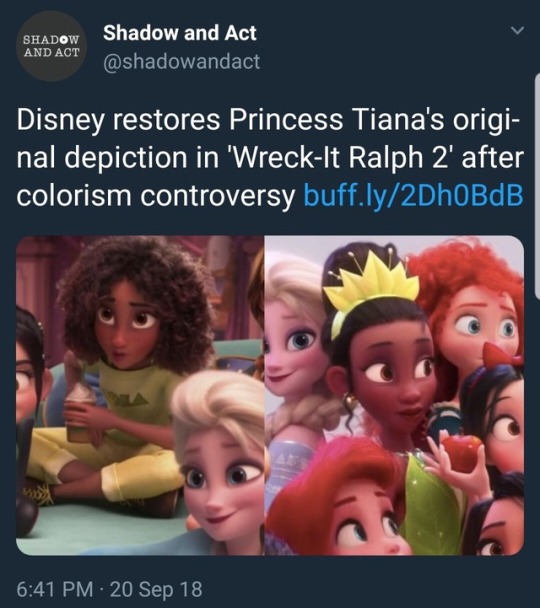
Walt Disney Co. DIS 1.67% has decided to reanimate scenes showing its only black princess in the coming “Wreck-It Ralph” sequel after facing criticism that the company had lightened her skin tone from previous appearances and narrowed her nose.
Princess Tiana, hailed as a breakthrough character for Disney when she first appeared in 2009’s “The Princess and the Frog,” is briefly featured in the “Wreck-It Ralph” sequel, called “Ralph Breaks the Internet.” After images of the princess were released by Disney over the summer, online users noted what they perceived as differences in pigmentation and facial features between the 2009 and 2018 versions of Tiana.
The social-media-driven backlash prompted Disney to begin reanimating the princess immediately after the images were released, according to a person familiar with the matter. The revisions—an unusual move given the yearslong process of making an animated film—come in the final months before the movie’s release on Nov. 21.
During the revision process, Disney animators weighed feedback from Anika Noni Rose, the actress who voices Tiana, and met with representatives from Color of Change, an advocacy organization that focuses on issues of racial representation and political inequality, including portrayals of black characters in Hollywood.
Brandi Collins-Dexter, a senior campaign director with Color of Change, traveled to Disney’s Burbank, Calif. headquarters last week for a review with the animators of the changes, which she described as darker hair and a wider nose and mouth.
In a statement Thursday, Color of Change praised Disney’s decision to “restore Princess Tiana’s image to that of an unapologetically black princess with full lips, dark skin and dark hair.”
This is called fixing it right. You screw up? Don’t blame the fans, or mock the people raising the issue. You reach out to the people your story represents and you ask for help to make it better.
Disney animators weighed feedback from Anika Noni Rose, the actress who voices Tiana, and met with representatives from Color of Change, an advocacy organization that focuses on issues of racial representation and political inequality, including portrayals of black characters
Animation isn’t cheap, and re-animation is even more expensive. I’m not going to hand out cookies for what’s still a token character — we have a long way to go — but it’s important to acknowledge Disney listened and acted.
That One Unnamed Extinction Event That Happened When Blue-Green Algae Discovered Photosynthesis and Started Pumping the Environment Full of Oxygen, Which Was Toxic to All Other Life on Earth at That Point in Time
This extinction event did result in the extinction of more living organisms than any other, whether you rank by number of individuals, number of orders/genera/species, % of life, or amount of biomass, but they were all single-celled organisms, so they don’t even register on the metal scale.
The Current Slow Slide Due to Anthropogenic Environmental Modification
Habitat destruction isn’t very metal.
Late Devonian
Some super-weird shit died out, which is totally metal, but we have no idea why, which isn’t. It might not even have been an extinction event, just a decrease in the speciation rate. Jawed vertebrates totally unaffected.
End Ordovician
Second-largest extinction event after the End Permian (not counting those blue-green algae fuckers). Caused by tectonic plate shifting (kinda metal) and resulting glaciation (mildly metal).
Deep Impact
Pros: Giant asteroid hitting the earth.
Cons: Fictional.
End Triassic
Probably caused by massive volcanic eruptions, which is pretty metal, but mostly just wiped out some weird looking amphibians, which is only mildly metal.
End Permian
Greatest extinction event of all time (with the exception of that blue-green algae fiasco mentioned above), wiping out ~95% of all species: metal. Only known mass extinction of insects: metal. Probably caused by the biggest volcanic eruptions since life began (metal) which ignited massive coal beds (metal) and caused the release of methane from the ocean floor (metal) resulting in a runaway greenhouse effect that raised the average ocean temperature to 40C for several million years, essentially boiling the earth alive (super metal). Paved the way for dinosaurs to take over the earth: metal. Known as the ‘Great Dying’: totally metal.
However, most of the extinctions occurred in sessile marine organisms, which are way too boring to be metal, and for the first ~20 million years after the extinction event, land was dominated by Lystrosaurus, which is the most un-metal looking reptile you can think of.
End Cretaceous, aka the K-T Event
A GIANT FLAMING BALL OF ROCK HIT THE EARTH AND KILLED ALL THE (non-avian) DINOSAURS. ENOUGH SAID.
I agree with most of this post (I’d swap Permian/Cretaceous because the Permian was freakin’ metal, yo, but no biggie) but you don’t get more metal than the GREAT OXYGEN CATASTROPHE
The entire surface of the earth was POISONED by a GAS that SHOULD NOT EXIST according to the basic LAWS OF THERMODYNAMICS
It’s so metal that even billions of years later Earth has had to evolve entire ecosystems that METABOLIZE DEADLY POISON GAS. And survive by EATING EACH OTHER (which was probably not a thing pre-OXYGEN HOLOCAUST, you don’t need to bother eating each other if you aren’t trying to survive in a world full of IMPOSSIBLE DEADLY GAS.) Earth’s original inhabitants now have to eke out an existence in sealed-off channels in SOLID ROCK and similar places.
THAT IS AS METAL AS IT GETS.
(also there’s the nuclear fission reactions and stuff, that part’s fun. Did the dinosaurs have nuclear fission? NO.)
I DID NOT KNOW IT WAS CALLED THE GREAT OXYGEN CATASTROPHE THAT MAKES IT EVEN BETTER
single-celled organisms are still not metal, though, so it remains in last place
I mean, yeah, O2, what a fucker, how is it even still around, it’s reactive as shit and eats literally everything it comes in contact with but
when 99.999999999999999999% of life on your planet gets wiped out by algae you don’t go around bragging about it
I’m just saying
algae
don’t say algae
LIFE
LIFE was destroyed by LIFE ITSELF
can’t you hear the distorted guitar riffs in the background
I get that, on an existential level, life being destroyed by life itself is very meta
I just don’t think it’s very metal
*dies from the toxic fumes emitted by that stinker*
No, you don’t understand, the Great Oxygen Catastrophe is literally metalbecause we can track it by banded iron formations that were created on the ancient seafloor through the mass oxidation of dissolved iron in the oceans. Fun fact: before cyanobacteria started farting out oxygen and choking the life out of anaerobic bacteria/triggering a ‘snowball Earth’ phase, the oceans would have looked green, not blue, due to all the dissolved iron. This can be observed today in oxygen-deprived lakes!











 thisacelovesheadcanons