“What? Like, a disabled protagonist? How would that even work? How could someone with a disability be the hero in an action show?” local anime trash boy wonders while sitting next to his box sets of Full Metal Alchemist, showing no hint of irony or self awareness.
but is Ed really disabled? sure I get he lost his arm and leg
but he’s still able to move and do things perfectly
He has prosthetics. Having prosthetic limbs (that more than once break amd need repair) doesnt make him not disabled
It should also be noted that Ed:
-had to undergo very painful surgery to get automail
-had to relearn how to write because of his prosthesis (there’s a post going around showing he had to switch hands etc) and his handwriting is likely a lot worse due to that. This means automail isn’t super good for delicate work, unsurprising, considering what it’s made of.
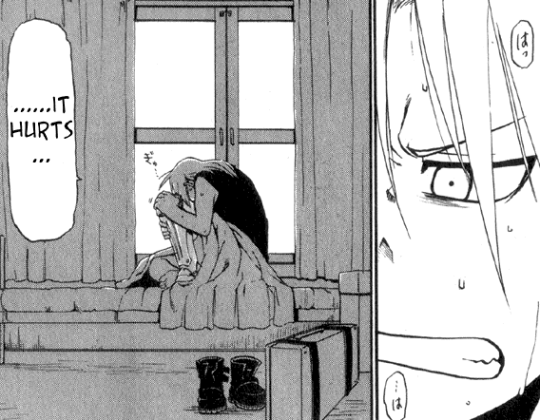
-experiences phantom limb pain and therefore other associated stuff (this was only really shown in the manga)
-cannot go anywhere too cold without changing his automail or he’ll get really bad frost bite and it will stop working
-cannot go anywhere too hot, period, because the metal attached and under his skin will overheat and he will be badly burned
-Reattachment is painful, but needs to be done frequently if he breaks or outgrows his automail
– it’s HEAVY so much so that the strain has the potential to cause stress on his body, enough that it’s even theorized as possibly stunting his growth.
-it requires regular maintenance or it will break down, as shown when he forgets to do that and it…breaks down
-when it does need to be repaired, it takes time to do that, during which Ed uses regular prosthetics (that usually don’t quite fit him).
-costs a lot of money (not a problem for Ed due to high state alchemist salary/having mechanics as surrogate family, but explicitly noted to being the reason why most people in the fmaverse stick to regular prosthetics along with the painful surgery)
So Ed can’t actually do everything perfectly and experiences a lot of extra hassle, problems and pain people without automail don’t have to deal with! And any advantages he does have are more suited to fighting than day to day life (being able to incorporate weapons/fake out people who want to blow up his arm).
Arakawa did her research and thought it through. Automail is by no means a magic cure that solves all problems associated with losing a limb.
This is barely an addition, but I’m pretty sure it was proven that it stunted his growth. It was mentioned in Dublith, and then Winry made him lighter automail in Briggs. Now, after a couple of days of being together, the two of them don’t meet up again for months.
When they finally meet up again:
You could argue something about angles here, but at the end of the series?
In conclusion, the original automail did stunt his growth.
As a writer, creating a disabled character can often be difficult. Ed only worked because the world he was created in has very advanced prosthetics which (despite some draw backs) move and acts exactly like real limbs. It’s a very particular case and required some additional write-arounds to make work. And plus the disability factored into the story which is good.
In many scenarios a disabled character simply wouldn’t work. And a writer isn’t obligated to make their character disabled.
Give an example of a story in which none of the characters truly and honestly could not be disabled in some form or fashion. Explain how it “simply wouldnt work.”
Because Im a writer, and that sounds like unimaginative laziness.
You shouldn’t shove disabled characters into a story for no reason. Why is there a disabled person there? Does their disability serve the story? Plot? Characterization? Did you make this character disabled just for a heck of it?
A soldier can’t be a soldier without both his arms. FMA fixes this with auto mail. Okay but what if the world you have created doesn’t have such advanced tech to give the soldier arms? Well he can’t be a soldier anymore. Sure you could probably spend a couple hours figuring this out, and if you want to more power to you, but why? Edwards disability served the story, if something doesn’t serve your story, world, plot, or characterization then it shouldn’t be in your writing.
I’m all for disabled characters, they’re as interesting as any other. But you people are acting like you need an excusenot to write a disabled character. I’ve written disabled characters, but not every story needs one and I don’t need a reason why.
The idea that including minority characters, even when they are explicitly needed, is “bad writing” is asinine, for the record. Minority characters are allowed to exist because the author wants them to.
And you didn’t answer my question. People in the military lose limbs all the time. Have you seen Forest Gump? And there’s more than one kind of disability. Soldiers can have PTSD, can have ADD, can be disabled in plenty of ways. Hell, in a MODERN military setting, you don’t need both arms to pilot a drone.
My point is that this argument that some stories just CANT have disabled characters is flawed. You havent disproved that.
For someone whom claims to know about writing. You sure can’t read.
I never said including minority characters is bad writing; you did, don’t ever fucking put words in my mouth. What I said is that the disability needs to serve the story like every other aspect of writing does.
Also yes, minority characters are allowed to exist just because the author wants them. But minority characters are also allow not to exist just because the author want that.
My example stands as it is. I specially said the setting didn’t allow for advanced prosthetics. And Lt Dan wasn’t a soldier after his disability now was he? As for the drone this yeah that could work but what if it’s a more mediaeval setting? My point is there will be times where a disabled character doesn’t always work 100% of the time. That’s okay. And hey, the opposite is true too. Sometimes a character might be better if they were disabled.
I have made my point you’re just stubborn and not listening.
Correction: You’ve made your point, and it’s moronic to anyone who has any knowledge of media analysis, and you’re obviously unequipped to understand why.
Nice ad hominem, it almost makes up for your lack of an argument.
“For someone who claims to know about writing, you sure can’t read.”
The difference is I actually had an argument and was pointing out that the other person didn’t read my reply properly.
You simply insulted me.
No, I insulted your point, which is not only riddled with factual inaccuracies that have been pointed out already, but also doesn’t hold up to the slightest philosophical inspection, which has also been demonstrated.
I then ALSO insulted your lack of reading comprehension, which you’re displaying again here.
An opinion can’t have factual inaccuracies when it’s on a subjective topic.
You didn’t address a single one of my points.
There you go again. Insulting me for no reason.
You want to actually get back to the discussion at hand? How about why I as a writer must write disabled characters in every story I have? Because my entire point is that not every story needs disabled people.
“Your point has factual inaccuracies.”
“AN OPINION CAN’T HAVE FACTUAL INACCURACIES!1!”
…you’re correct. That’s why I didn’t say your opinion had factual inaccuracies.
Honestly my dude, you need to come to the table with at least the most basic attempt at understanding if you want to be taken seriously in an argument. Otherwise you just can’t get mad when you aren’t taken seriously.
You…. quoted yourself saying that my point (see: opinion) has factual inaccuracies?
Do you see the issue with picking apart semantics rather than addressing the argument? Do you think you’re going to convince me?
Oh I have absolutely NO illusions that I’m going to convince you when you don’t understand even the most basic parts (i.e. the vocabulary) of the arguments that are presented to you.
You mean non-argument.
Because you’ve presented none.
Please tell me why ever character needs and should be disabled? Because if you don’t think that then you don’t disagree with me.
I am not at all surprised that you can look at this thread and not see any arguments presented.
Or that you think I disagree with you only if I subscribe to your obvious strawman.
I asked you a direct question regarding the argument and you didn’t answer it. You can’t argue and you just handed me the win. Thanks, that was easy, you’re dismissed.
You literally did not ask a direct question about the argument, and to all appearances it looks likes that’s because you have no idea what the argument is.
You certainly asked a question! It just wasn’t direct and didn’t have anything to do with the discussion.
Reading. It’s a good thing.
I feel like this would be a good moment to link the professional editor, @thebibliosphere and her post about disabilities and lazy writing to this dude because not everything in a story has to serve the plot. That’s unimaginative and boring. Seriously. Good ol’ worldbuilding for the sake of worldbuilding is amazing. People that think everything that happens is crucial to the plot are… boring. That over analysis of meta and other garbage is what makes literature classes especially boring.
Books are entertainment! Entertain me!
(also, while Toph’s blindness had some plot markers, it didn’t serve the overall plot in atla, so was her blindness then useless to this “writer” adrunkensailor? Probably)
Temples are built for gods. Knowing this a farmer builds a small temple to see what kind of god turns up.
Arepo built a temple in his field, a humble thing, some stones stacked up to make a cairn, and two days later a god moved in.
“Hope you’re a harvest god,” Arepo said, and set up an altar and burnt two stalks of wheat. “It’d be nice, you know.” He looked down at the ash smeared on the stone, the rocks all laid askew, and coughed and scratched his head. “I know it’s not much,” he said, his straw hat in his hands. “But – I’ll do what I can. It’d be nice to think there’s a god looking after me.”
The next day he left a pair of figs, the day after that he spent ten minutes of his morning seated by the temple in prayer. On the third day, the god spoke up.
“You should go to a temple in the city,” the god said. Its voice was like the rustling of the wheat, like the squeaks of fieldmice running through the grass. “A real temple. A good one. Get some real gods to bless you. I’m no one much myself, but I might be able to put in a good word?” It plucked a leaf from a tree and sighed. “I mean, not to be rude. I like this temple. It’s cozy enough. The worship’s been nice. But you can’t honestly believe that any of this is going to bring you anything.”
“This is more than I was expecting when I built it,” Arepo said, laying down his scythe and lowering himself to the ground. “Tell me, what sort of god are you anyway?”
“I’m of the fallen leaves,” it said. “The worms that churn beneath the earth. The boundary of forest and of field. The first hint of frost before the first snow falls. The skin of an apple as it yields beneath your teeth. I’m a god of a dozen different nothings, scraps that lead to rot, momentary glimpses. A change in the air, and then it’s gone.”
The god heaved another sigh. “There’s no point in worship in that, not like War, or the Harvest, or the Storm. Save your prayers for the things beyond your control, good farmer. You’re so tiny in the world. So vulnerable. Best to pray to a greater thing than me.”
Arepo plucked a stalk of wheat and flattened it between his teeth. “I like this sort of worship fine,” he said. “So if you don’t mind, I think I’ll continue.”
“Do what you will,” said the god, and withdrew deeper into the stones. “But don’t say I never warned you otherwise.”
Arepo would say a prayer before the morning’s work, and he and the god contemplated the trees in silence. Days passed like that, and weeks, and then the Storm rolled in, black and bold and blustering. It flooded Arepo’s fields, shook the tiles from his roof, smote his olive tree and set it to cinder. The next day, Arepo and his sons walked among the wheat, salvaging what they could. The little temple had been strewn across the field, and so when the work was done for the day, Arepo gathered the stones and pieced them back together.
“Useless work,” the god whispered, but came creeping back inside the temple regardless. “There wasn’t a thing I could do to spare you this.”
“We’ll be fine,” Arepo said. “The storm’s blown over. We’ll rebuild. Don’t have much of an offering for today,” he said, and laid down some ruined wheat, “but I think I’ll shore up this thing’s foundations tomorrow, how about that?”
The god rattled around in the temple and sighed.
A year passed, and then another. The temple had layered walls of stones, a roof of woven twigs. Arepo’s neighbors chuckled as they passed it. Some of their children left fruit and flowers. And then the Harvest failed, the gods withdrew their bounty. In Arepo’s field the wheat sprouted thin and brittle. People wailed and tore their robes, slaughtered lambs and spilled their blood, looked upon the ground with haunted eyes and went to bed hungry. Arepo came and sat by the temple, the flowers wilted now, the fruit shriveled nubs, Arepo’s ribs showing through his chest, his hands still shaking, and murmured out a prayer.
“There is nothing here for you,” said the god, hudding in the dark. “There is nothing I can do. There is nothing to be done.” It shivered, and spat out its words. “What is this temple but another burden to you?”
“We -” Arepo said, and his voice wavered. “So it’s a lean year,” he said. “We’ve gone through this before, we’ll get through this again. So we’re hungry,” he said. “We’ve still got each other, don’t we? And a lot of people prayed to other gods, but it didn’t protect them from this. No,” he said, and shook his head, and laid down some shriveled weeds on the altar. “No, I think I like our arrangement fine.”
“There will come worse,” said the god, from the hollows of the stone. “And there will be nothing I can do to save you.”
The years passed. Arepo rested a wrinkled hand upon the temple of stone and some days spent an hour there, lost in contemplation with the god.
And one fateful day, from across the wine-dark seas, came War.
Arepo came stumbling to his temple now, his hand pressed against his gut, anointing the holy site with his blood. Behind him, his wheat fields burned, and the bones burned black in them. He came crawling on his knees to a temple of hewed stone, and the god rushed out to meet him.
“I could not save them,” said the god, its voice a low wail. “I am sorry. I am sorry. I am so so sorry.” The leaves fell burning from the trees, a soft slow rain of ash. “I have done nothing! All these years, and I have done nothing for you!”
“Shush,” Arepo said, tasting his own blood, his vision blurring. He propped himself up against the temple, forehead pressed against the stone in prayer. “Tell me,” he mumbled. “Tell me again. What sort of god are you?”
“I -” said the god, and reached out, cradling Arepo’s head, and closed its eyes and spoke.
“I’m of the fallen leaves,” it said, and conjured up the image of them. “The worms that churn beneath the
earth. The boundary of forest and of field. The first hint of frost
before the first snow falls. The skin of an apple as it yields beneath
your teeth.” Arepo’s lips parted in a smile.
“I am the god of a dozen different nothings,” it said. “The petals in bloom that lead to
rot, the momentary glimpses. A change in the air -” Its voice broke, and it wept. “Before it’s gone.”
“Beautiful,” Arepo said, his blood staining the stones, seeping into the earth. “All of them. They were all so beautiful.”
And as the fields burned and the smoke blotted out the sun, as men were trodden in the press and bloody War raged on, as the heavens let loose their wrath upon the earth, Arepo the sower lay down in his humble temple, his head sheltered by the stones, and returned home to his god.
i always know when a fic writer has never experienced a hickey
How? It’s not like you’ve experienced one either.
“[Character A] licked and nibbled [Character B]’s collarbone, leaving dark purple spots along the way.”
either they’re tossing away the meaning of “nibbled” for the advancement of smut or they have a solid misunderstanding of hickeys. it takes like four or five straight seconds of hard suction to make a spot “dark purple”.
okay so two options here:
“[Character A] licked and nibbled [Character B]’s collarbone, leaving faint pink spots along the way.”
OR (and this one is better imo)
“[character A] sucked on the skin of [character B]’s collarbone harder than a vacuum on high power, leaving behind appropriately dark purple hickeys”
“[Character A] puckered their lips and absolutely Hoover™’d the life out of [Character B]’s entire neck. ‘You DirtDevil™’ [Character B] said with a breathy sigh.”
CHARACTER A sucked on CHARACTER B’s neck for a suspiciously long time and caused a sharp fucking pain leading CHARACTER B to shout FOR FUCK’S SAKE I HAVE TO GO TO WORK TOMORROW


 thisacelovesheadcanons